Tuesday, 30 April 2013

Unit X: Location, Location, Location!


To give an idea of the sort of scale we want to work towards, here are some installation artists that I have found as inspiration. Over the weekend, we found that once we pulled our knit samples we could stretch them out and manipulate them so that they could span a larger space and form cool geometric shapes. But to progress any further we need to settle on a location so that we have a better idea of how much we need to knit. Surprisingly, it doesn't take too long to arm knit a large piece and isn't particularly laborious so can be easily done whilst watching the telly!

 I'm currently waiting for the film-people to see if they've got a film location in mind to give us an indicator of space we will have to cover. For this, Rachael has suggested filming in Antwerp Mansion and is in the process of emailing them for permission. As for finding a location for the actually exhibition, we have discussed what kind of space we are after and have agreed on looking for a blank white space that we could cover entirely in the knit. 

For our experiment in my flat, we used very conspicuous masking tape to anchor the knit to the walls. As tape will not do for the final exhibition, what I am concerned about is how many spaces will be happy to let us hammer nails into the wall! As a solution to this, I proposed building a wooden scaffold-type structure that we could construct on-site. This will give us a frame to work within and tie on bits of yarn that will hold the installation, with the film displayed in the centre of it. But in our tutorial, Robin rightly pointed out that this might just be unnecessary bother and that we wont actually know what we're working with until we find a location. 

But since we don’t have very long left, we should probably get a move on!

Monday, 29 April 2013

Unit X: Arm Knitting Part 2

Following on from our experiment with arm knitting, I took the opportunity to photograph the samples in the evening using dim directional lighting to try and capture the shadows that it cast on the wall. I think there is something quite beautiful about the intricate patterns created by the knit that is quite sinister and eerie at the same time. 


Sunday, 28 April 2013

Unit X: Arm Knitting


The object of this weekend was Scale! Lizzie came over to my flat to get to work on trailing a knit installation. I was very impressed with her knit samples from last week as they were very tactile and even Robin pointed out that throughout the tutorial she simply couldn't stop handling them! What I was interested in was pushing them further in terms of scale and trying to see how we could create 3D shapes out of them.

Because we probably wouldn't be able to source big enough knitting needles for the sort of scale we had in mind, I suggested we try arm knitting after seeing a small sample of it from a friend on the course.  Below is  the Youtube tutorial that we used.


We popped into Abakhans on Saturday morning and since we were just interested in sampling the technique we weren’t particularly fussed about what kind of yarn we used. In the end, we settled for deep purple medium weight yarn and a mossy green yarn that was much finer to give us an idea of the difference in textures. After a bit of fiddling about, we found that the arm knitting process was pretty easy to grasp and were able to make a sample using a whole ball of yarn surprisingly quickly.


Once we had our samples, all we could do next was find some space and start putting it up. We didn't have much of a plan for this as we haphazardly started to stick up random corners of the knit. We found that we liked that shape of the knit when it was pulled taut and twisted to different angles.
Also, as we were knitting I found that my sample was much tighter than Lizzie’s; most likely due to my inability to let go and knit loose ‘messy’ structures! But in the process of hanging up the two pieces we were interested in the contrasting densities between them. In a previous meeting we had talked about the installation being concentrated at a central point and expanding outwards. So the two knit samples worked well in the sense that we could vary the tightness of the stitches in order to portray different densities.


We thought about using different thicknesses of yarns side by side, again as a means of portraying a concentration of energy and outward movement. So the idea is that the yarns used in the centre of the installation could be thick and become progressively finer as we reach the peripheries of the piece.  This is dependent on what we can source as there wasn't a great range available at Abakhan.
Finally, we thought about colour and the possibility of using a gradient colour scheme that uses darker yarns in the centre and lighter yarns as it moves outwards.

Overall, I think this was a successful experiment and we are definitely edging closer to defining our final outcome.


Friday, 26 April 2013

Unit X: Harmony from Discord


This week has been a stressful one! There has been much biting of tongues and Facebook based venting!
 It all began with our lecture with Anne Douglas. Anne's work is based primarily takes on a curatorial role is excited by the process of bringing together completely different fields such as fine-art and science bring the audience an exciting artistic experience. One question she got us to think about in the lecture was that can a collaboration be successful even if the outcome is not? Her argument was Yes, it can. This is because collaborations are all about the sharing of skills and knowledge and therefore much can be gained from the actual experience of collaboration. If the end product is successful then clearly the collaboration worked well, but all in all it is a process of trial and error.

With this in mind, Anne Douglas was the perfect person to sit in on our Tuesday tutorials Robin and Eleanor. But all did not go to plan. For starters, the only people that turned up were myself and Lizzie from the installation sub-group and Millie from the film sub-group. Not a great turn out! We were asked to pitch our idea so far and the tutors took a positive interest in what we had to say about the installation.They were particularly interested in Lizzie’s knit samples because of how tactile they were.  However, as Millie was the only one present from the film group, I don’t think she was quite able to do justice to their ideas on her own and since we had not been involved in that process, neither could we. This led Anne to question our decision to work separately and she stressed that we were completely missing the point of the collaborative unit. At this point I must admit, the whole sub-group scenario was a bit of an easy way out of having to manage such a large group!

For the remainder of the meeting, Anne talked to us about the ways in which we could combine the film and installation as a sort of performance piece where we could invite the audience to experience the installation as a sort of guided tour and film the reaction. Whilst her ideas were all very exciting, we left the tutorial feeling a little dazed and confused.

Things only got worse when the news hit Facebook. I would post a screenshot of the conversation but it’s a little messy! The problem was that Millie posted a panicked message about how we were being asked to change our ideas. Somewhere along the line this got heavily misconstrued and things got pretty heated as people were not happy about though of dropping ideas.

Needless to say, I was pretty nervous when we called for an emergency group meeting. Thankfully, we had all cooled down a bit and were able to talk about how we could intergrate the film and installation. At first we talked about the knit being part of the set design to go with the film.  But as we went on to brainstorm scene ideas I was a little concerned that the story line had nothing to do with our plans for the installation at all. I think it was a little difficult for the group to visualise how it would fit in as we haven’t yet gotten around to sampling anything on a larger scale and as a consequence couldn't really show them what we had in mind.

As the narrative the film-people had in mind was based around irrational fears, I suggested that the knit could be a figurative representation of this that is present throughout the footage. The fact that it would be more in the background for some of the scenes might add to the sinister connotations as fear can be portrayed as something that is ever present. 

I think after all that fuss, we might actually be in agreement. All we need to do now is to get cracking on some large scale knit samples!

Sunday, 21 April 2013

Unit X: Sampling

Following on from our meeting, this weekend I have been busy sampling with various material. My initial research looked at objects that were used in Voodoo rituals so I thought it would be a nice idea to make casts of objects, maybe those that had sentimental value, to display as part of our installation. For this I decided to keep it simple and use watered- down PVA glue to fuse various materials together in a moulded shape. Inspiration for this came from Lizzie’s research into the work of artist Anna Mortimer who uses heat fusion to mould fabric into delicate cocoon-like objects which she embroiders and puts together as beautiful globular clusters.


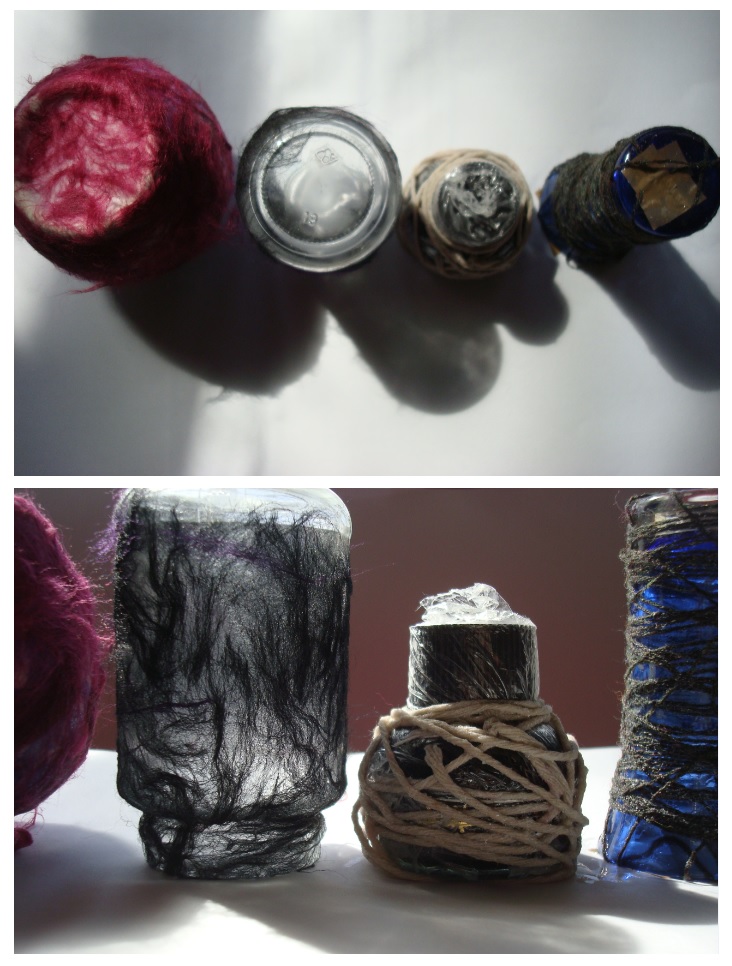
So I started by covering a small vase with patches of loose wool fibres (kindly donated to me by Flavia) and soaking it in watered-down PVA glue. I was quite happy to keep my layers quite uneven and haphazard as I was interested in the way light would pass through the varied densities.


Whilst that was left to dry, I repeated technique by wrapping thick string around an ink bottle and some thin yarn around another vase. Again, my aim was not to be too precise and leave random gaps in between the layers to allow for light to pass through. 


As I had really soaked the pieces I found that it took ages to dry! But as it was a nice day I was able to take some pictures of my experiments in good light. In some ways this worked better with the coloured glass as a base for the wool and string outer shells as it accentuated the light and shadows. 


Once dry, the samples weren’t quite as successful as I had hoped. I found that the samples simply didn’t hold their shape once they had been peeled off their bases. Particularly, the wool fibres began to come off in clumps once it started to peel it and would probably start to shed every time I handled it! But this might simply be down to my PVA to Water ratio. What might have been a half-success however might be the string and yarn structures. Again, these did not hold their shape properly but once removed from the base structure, it was almost as though the yarn took on a skeletal resemblance of the object that formed it. 

Saturday, 20 April 2013

Unit X: Brass Art


The week before we broke up for Easter, me and my friend Sonia gate-crashed an art lecture. I say gate-crashed because after about 5 minutes we realised that we were the only fashion students in the entire lecture theatre and the content wasn't really directed at us at all. Nevertheless, it’s probably the most bad-ass thing I shall ever do!

But this being a collaborative unit and possibly the only chance we will have to deviate from everything fashion, this incident turned out to be a bit of a ‘happy accident’. For you see, the lecture was headed by Chara Lewis, a member of the Manchester based artist collective, Brass Art.

We came across a piece of their work in September last year at the Tatton Biennial entitled Flights of Fancy. For this, the collective exhibited a site specific inflatable sculpture called Trine Messenger (2012). Taking inspiration from classical images of Hypnos, the collective’s surreal piece was an amalgamation of each member’s face using 3D and 4D bio-medical facial scanning.  Sadly, when we visited Tatton Park, the sculpture had started to deflate so we did not get to see it all its glory. But from its documentation on the collective’s website I can see that this was clearly an impressive piece. The fact that it was stark white alludes to marble sculptures, almost as an echo of the inter-mingling of modern technology and classic art forms.

Trine Messenger at Tatton Park, 2012

A lot of their work revolves around the interplay between light and shadows. For example the series of watercolour silhouette drawings produced as part of ‘The Non-existence of the Unnamed’ (2010) series were exhibited in a dark room in which the artists installed just one light bulb. This brought the notion of shadows playing tricks on the mind to the audience whose own shadows would mingle with the figures on the wall. In this way, the drawings almost become an installation as it is as though the eerie silhouettes were emerging out of the canvas like some portal to another realm.

The Non-Existence of the Unnamed at The International 3 Gallery, 2010

I am interested in how the collective utilises space to play an active role in their installation. For example, the installation ‘Still Life No.1’ (2011) was a result of their ongoing fascination with 3D laser printing, with which they created miniature figurines of themselves. These figurines were displayed alongside other small scale sculptures made out of cheaper materials such as cellophane. They worked alongside a theatre technician to create a rotating table with its own light source on which to display the collection of objects. This gave the mini-sculptures a new dimension as the shadows created by the rotating table created ever-changing shadows on the walls of the gallery space, almost like a live shadow play. I think this is a lovely idea as the installation in itself was not particularly big but still the artists managed to fully utilise the space in an interactive manner. In this way, the difference between the expensive 3D printed figurines and the cellophane is lost entirely as the shadows cast on the walls reveal nothing of their origins.

Still Life No.1 at The Whitworth Art Gallery, 2011

*images taken from the artist's website


Thursday, 18 April 2013

Unit X: Zero-Waste Pattern Cutting with Fiona Mills


Our lecture with Fiona Mills was an introduction into the concept of Zero Waste pattern cutting. The objective of this process is quite simply to reduce the amount of waste produced in the creative and commercial pattern cutting process. Shockingly, 15-20% of fabric waste is produced at this stage in current commercial practice with even greater waste produced by high-end designers as a result of their elaborate and complicated designs. This is worrying as, despite the protestations of many big brands, much of that waste does not get reused or recycled. This is even more of a problem now as fashion is fast moving and the seasonal trends mean that more garments are produced at a quicker pace; therefore greater wastage.
It is then interesting that though this is a contemporary issue, the practice of Zero Waste Pattern Cutting has been around for centuries and takes inspiration from the first garments ever produced. This harks back to a time when fabric was a valuable commodity as Roman and Grecian garments would be constructed using entire lengths of fabric and shaped simply by tucking and draping.


Fiona then spoke to us about the Yield exhibition held in New Zealand in 2011 that celebrated the use of Zero Waste in modern practice. The exhibition brought together a diverse cross-section of designers and researchers that are the forerunners of this field. This ranged from young designers such as Julia Hamsden, a recent design student, who works primarily with menswear and uses the waste pattern to create quirky grown-on details on generic garments for the commercial sector. On the other end of the spectrum, there are designers such as Yeohlee Tang who create garments for high fashion who have experimented with the technique for a high-fashion market.

The lecture followed an afternoon workshop with Fiona herself who has just completed a masters with her research based around transforming commercial and designer patterns into Zero-Waste garments. As part of the workshop, we were given a set of pattern designs from the Yield exhibition and were asked to recreate the design without any instructions. This struck me as a bit of an odd request as I regard pattern-cutting as being about precision and accuracy. But Fiona assured us that it was just about having fun with the construction process and being creative.


I decided to take her word for it and chose to work with a skirt pattern by Yeolee Tang. It seemed simple enough but when I got down to cutting and reassembling the pieces I just couldn't figure out how to put it all together so that it looked like a designer skirt. I really didn't help that I didn't have any clear images to see what the end product should look like so essentially I was trying to re-create something that I had never seen before! Since I have major control issues, this was quite a frustrating process. But Fiona was pretty encouraging and eventually I managed to fit all the pieces fit together so that they actually resembled a garment.

Aggravatingly, when I got home I Googled an image of the garment I had tried to recreate and it turned out that my skirt looked nothing like the original! *deep breaths* 


But I won’t lose my mind completely as at the end of it all Fiona reminded me that the process was just about experimentation and creating original designs through the process of problem solving. This is something I'm very interested and might even take another crack at it when I start designing for my next project. All in all, a really great lecture with an equally engaging and friendly lecturer.