Showing posts with label Research. Show all posts

Wednesday, 1 May 2013

Unit X: Arm Knitting- Now with Fabric!


During our tutorial yesterday, Robin suggested that we try using alternative materials to yarn as we should be trying to set up the exhibition practically for free. That’s perfectly fine by me! Lizzie mentioned that she had tried knitting with torn strips of fabric. He suggested that we try looking into a charity warehouse called Grumpy’s that sold very cheap crafts items. Unfortunately, it later turned out that the Manchester branch had been closed down due to lack of funding in March. The consolation was that if we got desperate we could always make a trek to Stockport for its alternative branch if we needed to. That's if we get really desperate!


But for the time being we could always make use of scraps of fabric from past projects that we no doubt had laying about (I have a tendency to buy too much fabric...though I’m sure you can never have too much fabric!).  For once I had a little extra time on my hands today so I thought I would give it a go.


I did this by very simply tearing a sheet of cotton into strips and as this was a quick experiment I simply tied the ends together to make a continuous trail. The strips of fabric then were quite easy to knit but the only problem was that unlike the yarns we used in our trail installation over the weekend, the finished piece did not stretch as much as I would like. At the moment, I can’t really see us using this version of the technique in our installation but it was worth a try!


Tuesday, 30 April 2013

Unit X: Location, Location, Location!


To give an idea of the sort of scale we want to work towards, here are some installation artists that I have found as inspiration. Over the weekend, we found that once we pulled our knit samples we could stretch them out and manipulate them so that they could span a larger space and form cool geometric shapes. But to progress any further we need to settle on a location so that we have a better idea of how much we need to knit. Surprisingly, it doesn't take too long to arm knit a large piece and isn't particularly laborious so can be easily done whilst watching the telly!

 I'm currently waiting for the film-people to see if they've got a film location in mind to give us an indicator of space we will have to cover. For this, Rachael has suggested filming in Antwerp Mansion and is in the process of emailing them for permission. As for finding a location for the actually exhibition, we have discussed what kind of space we are after and have agreed on looking for a blank white space that we could cover entirely in the knit. 

For our experiment in my flat, we used very conspicuous masking tape to anchor the knit to the walls. As tape will not do for the final exhibition, what I am concerned about is how many spaces will be happy to let us hammer nails into the wall! As a solution to this, I proposed building a wooden scaffold-type structure that we could construct on-site. This will give us a frame to work within and tie on bits of yarn that will hold the installation, with the film displayed in the centre of it. But in our tutorial, Robin rightly pointed out that this might just be unnecessary bother and that we wont actually know what we're working with until we find a location. 

But since we don’t have very long left, we should probably get a move on!

Monday, 29 April 2013

Unit X: Arm Knitting Part 2

Following on from our experiment with arm knitting, I took the opportunity to photograph the samples in the evening using dim directional lighting to try and capture the shadows that it cast on the wall. I think there is something quite beautiful about the intricate patterns created by the knit that is quite sinister and eerie at the same time. 


Sunday, 28 April 2013

Unit X: Arm Knitting


The object of this weekend was Scale! Lizzie came over to my flat to get to work on trailing a knit installation. I was very impressed with her knit samples from last week as they were very tactile and even Robin pointed out that throughout the tutorial she simply couldn't stop handling them! What I was interested in was pushing them further in terms of scale and trying to see how we could create 3D shapes out of them.

Because we probably wouldn't be able to source big enough knitting needles for the sort of scale we had in mind, I suggested we try arm knitting after seeing a small sample of it from a friend on the course.  Below is  the Youtube tutorial that we used.


We popped into Abakhans on Saturday morning and since we were just interested in sampling the technique we weren’t particularly fussed about what kind of yarn we used. In the end, we settled for deep purple medium weight yarn and a mossy green yarn that was much finer to give us an idea of the difference in textures. After a bit of fiddling about, we found that the arm knitting process was pretty easy to grasp and were able to make a sample using a whole ball of yarn surprisingly quickly.


Once we had our samples, all we could do next was find some space and start putting it up. We didn't have much of a plan for this as we haphazardly started to stick up random corners of the knit. We found that we liked that shape of the knit when it was pulled taut and twisted to different angles.
Also, as we were knitting I found that my sample was much tighter than Lizzie’s; most likely due to my inability to let go and knit loose ‘messy’ structures! But in the process of hanging up the two pieces we were interested in the contrasting densities between them. In a previous meeting we had talked about the installation being concentrated at a central point and expanding outwards. So the two knit samples worked well in the sense that we could vary the tightness of the stitches in order to portray different densities.


We thought about using different thicknesses of yarns side by side, again as a means of portraying a concentration of energy and outward movement. So the idea is that the yarns used in the centre of the installation could be thick and become progressively finer as we reach the peripheries of the piece.  This is dependent on what we can source as there wasn't a great range available at Abakhan.
Finally, we thought about colour and the possibility of using a gradient colour scheme that uses darker yarns in the centre and lighter yarns as it moves outwards.

Overall, I think this was a successful experiment and we are definitely edging closer to defining our final outcome.


Friday, 26 April 2013

Unit X: Harmony from Discord


This week has been a stressful one! There has been much biting of tongues and Facebook based venting!
 It all began with our lecture with Anne Douglas. Anne's work is based primarily takes on a curatorial role is excited by the process of bringing together completely different fields such as fine-art and science bring the audience an exciting artistic experience. One question she got us to think about in the lecture was that can a collaboration be successful even if the outcome is not? Her argument was Yes, it can. This is because collaborations are all about the sharing of skills and knowledge and therefore much can be gained from the actual experience of collaboration. If the end product is successful then clearly the collaboration worked well, but all in all it is a process of trial and error.

With this in mind, Anne Douglas was the perfect person to sit in on our Tuesday tutorials Robin and Eleanor. But all did not go to plan. For starters, the only people that turned up were myself and Lizzie from the installation sub-group and Millie from the film sub-group. Not a great turn out! We were asked to pitch our idea so far and the tutors took a positive interest in what we had to say about the installation.They were particularly interested in Lizzie’s knit samples because of how tactile they were.  However, as Millie was the only one present from the film group, I don’t think she was quite able to do justice to their ideas on her own and since we had not been involved in that process, neither could we. This led Anne to question our decision to work separately and she stressed that we were completely missing the point of the collaborative unit. At this point I must admit, the whole sub-group scenario was a bit of an easy way out of having to manage such a large group!

For the remainder of the meeting, Anne talked to us about the ways in which we could combine the film and installation as a sort of performance piece where we could invite the audience to experience the installation as a sort of guided tour and film the reaction. Whilst her ideas were all very exciting, we left the tutorial feeling a little dazed and confused.

Things only got worse when the news hit Facebook. I would post a screenshot of the conversation but it’s a little messy! The problem was that Millie posted a panicked message about how we were being asked to change our ideas. Somewhere along the line this got heavily misconstrued and things got pretty heated as people were not happy about though of dropping ideas.

Needless to say, I was pretty nervous when we called for an emergency group meeting. Thankfully, we had all cooled down a bit and were able to talk about how we could intergrate the film and installation. At first we talked about the knit being part of the set design to go with the film.  But as we went on to brainstorm scene ideas I was a little concerned that the story line had nothing to do with our plans for the installation at all. I think it was a little difficult for the group to visualise how it would fit in as we haven’t yet gotten around to sampling anything on a larger scale and as a consequence couldn't really show them what we had in mind.

As the narrative the film-people had in mind was based around irrational fears, I suggested that the knit could be a figurative representation of this that is present throughout the footage. The fact that it would be more in the background for some of the scenes might add to the sinister connotations as fear can be portrayed as something that is ever present. 

I think after all that fuss, we might actually be in agreement. All we need to do now is to get cracking on some large scale knit samples!

Sunday, 21 April 2013

Unit X: Sampling

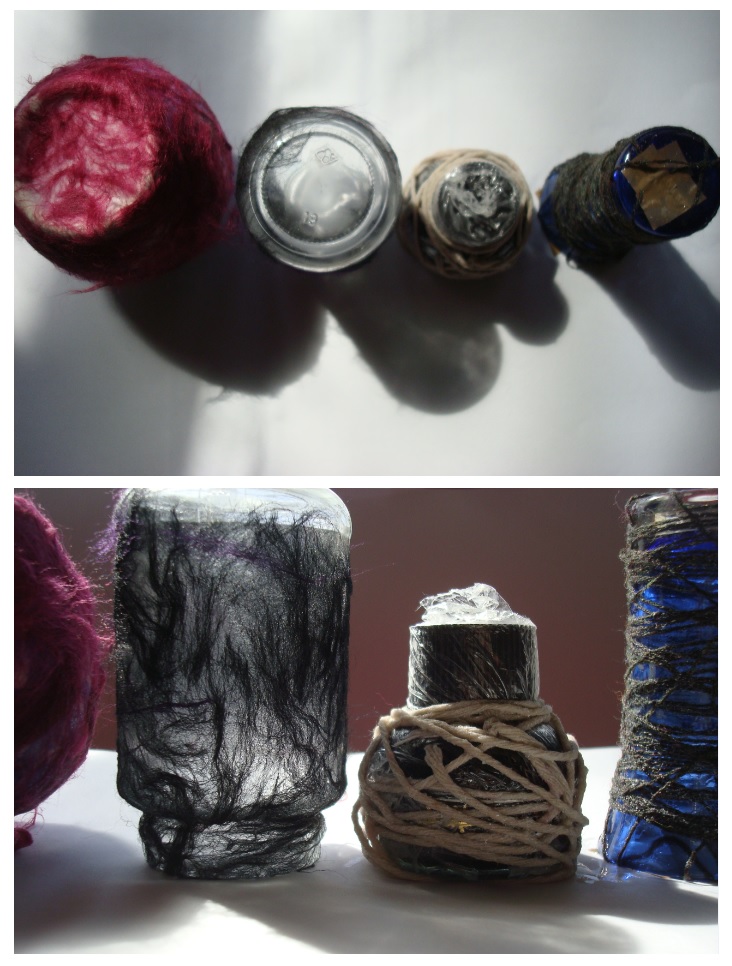
Following on from our meeting, this weekend I have been busy sampling with various material. My initial research looked at objects that were used in Voodoo rituals so I thought it would be a nice idea to make casts of objects, maybe those that had sentimental value, to display as part of our installation. For this I decided to keep it simple and use watered- down PVA glue to fuse various materials together in a moulded shape. Inspiration for this came from Lizzie’s research into the work of artist Anna Mortimer who uses heat fusion to mould fabric into delicate cocoon-like objects which she embroiders and puts together as beautiful globular clusters.


So I started by covering a small vase with patches of loose wool fibres (kindly donated to me by Flavia) and soaking it in watered-down PVA glue. I was quite happy to keep my layers quite uneven and haphazard as I was interested in the way light would pass through the varied densities.


Whilst that was left to dry, I repeated technique by wrapping thick string around an ink bottle and some thin yarn around another vase. Again, my aim was not to be too precise and leave random gaps in between the layers to allow for light to pass through. 


As I had really soaked the pieces I found that it took ages to dry! But as it was a nice day I was able to take some pictures of my experiments in good light. In some ways this worked better with the coloured glass as a base for the wool and string outer shells as it accentuated the light and shadows. 


Once dry, the samples weren’t quite as successful as I had hoped. I found that the samples simply didn’t hold their shape once they had been peeled off their bases. Particularly, the wool fibres began to come off in clumps once it started to peel it and would probably start to shed every time I handled it! But this might simply be down to my PVA to Water ratio. What might have been a half-success however might be the string and yarn structures. Again, these did not hold their shape properly but once removed from the base structure, it was almost as though the yarn took on a skeletal resemblance of the object that formed it. 

Saturday, 20 April 2013

Unit X: Brass Art


The week before we broke up for Easter, me and my friend Sonia gate-crashed an art lecture. I say gate-crashed because after about 5 minutes we realised that we were the only fashion students in the entire lecture theatre and the content wasn't really directed at us at all. Nevertheless, it’s probably the most bad-ass thing I shall ever do!

But this being a collaborative unit and possibly the only chance we will have to deviate from everything fashion, this incident turned out to be a bit of a ‘happy accident’. For you see, the lecture was headed by Chara Lewis, a member of the Manchester based artist collective, Brass Art.

We came across a piece of their work in September last year at the Tatton Biennial entitled Flights of Fancy. For this, the collective exhibited a site specific inflatable sculpture called Trine Messenger (2012). Taking inspiration from classical images of Hypnos, the collective’s surreal piece was an amalgamation of each member’s face using 3D and 4D bio-medical facial scanning.  Sadly, when we visited Tatton Park, the sculpture had started to deflate so we did not get to see it all its glory. But from its documentation on the collective’s website I can see that this was clearly an impressive piece. The fact that it was stark white alludes to marble sculptures, almost as an echo of the inter-mingling of modern technology and classic art forms.

Trine Messenger at Tatton Park, 2012

A lot of their work revolves around the interplay between light and shadows. For example the series of watercolour silhouette drawings produced as part of ‘The Non-existence of the Unnamed’ (2010) series were exhibited in a dark room in which the artists installed just one light bulb. This brought the notion of shadows playing tricks on the mind to the audience whose own shadows would mingle with the figures on the wall. In this way, the drawings almost become an installation as it is as though the eerie silhouettes were emerging out of the canvas like some portal to another realm.

The Non-Existence of the Unnamed at The International 3 Gallery, 2010

I am interested in how the collective utilises space to play an active role in their installation. For example, the installation ‘Still Life No.1’ (2011) was a result of their ongoing fascination with 3D laser printing, with which they created miniature figurines of themselves. These figurines were displayed alongside other small scale sculptures made out of cheaper materials such as cellophane. They worked alongside a theatre technician to create a rotating table with its own light source on which to display the collection of objects. This gave the mini-sculptures a new dimension as the shadows created by the rotating table created ever-changing shadows on the walls of the gallery space, almost like a live shadow play. I think this is a lovely idea as the installation in itself was not particularly big but still the artists managed to fully utilise the space in an interactive manner. In this way, the difference between the expensive 3D printed figurines and the cellophane is lost entirely as the shadows cast on the walls reveal nothing of their origins.

Still Life No.1 at The Whitworth Art Gallery, 2011

*images taken from the artist's website


Wednesday, 17 April 2013

Unit X: Installation Sub-Group

This year has been very much about trial and error. At first, I felt compelled to abandon the ways of working I had adopted in my previous foundation year, which was geared more towards textiles, and approached the course with a preconceived notion of how a fashion designer must design.  Unfortunately, what I imagined to be the ‘correct’ way of working did not translate into the correct way of working for me and I have found myself struggling to design in a way that reflects my artistic sensibilities. This is why, I was so excited to use this unit as a chance to step outside the confines of the course and begin to explore different ways of working.  I am still interested in the practical making of things which is why; when it came to thinking about the final outcome I was more inclined to work towards some form of large-scale installation. Thankfully, as a result of last week’s tutorial with Louise who gave us the option of creating more than one outcome, I was joined by Flavia and Lizzie as we formed a subgroup. Like me, the girls are interested in working with textiles and prefer a tactile and hands-on approach to making.

We came together as a sub-group today where we went through our research and talked about what sort of medium we’d be interested in working with.Whilst I enjoy working consistently on my own to develop a narrative for my work, when it comes to realising those ideas into an actual outcome I find myself a bit lost for direction. In this way, I think working with a team (though now smaller than originally intended) will benefit me as already we were bouncing off each other’s ideas.

It emerged that whilst Lizzie and Flavia had ideas of what they would want to work with in terms of the final outcome, due to having to change the direction of their research according to our turbulent group discussions, they had not defined a research concept. The general feeling was that each time we had a meeting, ideas were changed and in turn research had to be altered accommodate those changes. 
My research had the advantage here as I had stubbornly refused to change my research as I wanted to continue to develop a strong narrative on which to base our groups ideas. I guess that’s not quite being a team player but it has worked out for the best as the other two were happy to continue with my conceptual research.

The concept we have settled on is that of ‘Evil Reflected’ as illustrated in the images below taken from my sketchbook.

Collage using image of a 'Gris-Gris' talisman. Pencil, Tracing Paper.
Collage based on photograph of Horse skull.  Pen, Watercolour.
Despite the fact that this research came from looking at Voodoo, our aim is to make the final outcome more of a figurative representation of the original concept. Both illustrations show sharp forms protruding from objects, so we talked about potentially making structures that raise up from a fixed point in a space, i.e. either upwards from the ground our as a hanging installation from the ceiling. As inspiration for this, we thought about the work of artist Cornelia Parker, whose piece ‘Cold Dark Matter’ is an exploded view of a garden shed that appears to be suspended in motion. 


Cornelia Parker, Cold Dark Matter- An Exploded View. Exhibited at Tate Modern(1991)

What we particularly liked about this was the fact that all of the individual components were concentrated at a central point and then expanded outwards into the larger gallery space. Lighting is an important component here as again its central positioning almost suggests a source of energy.
Finally, we are interested in fully utilising space by playing around with lighting to cast shadows. To achieve this we have a number of ideas that we aim to sample during this week.
  • I want to continue to play around with fabric manipulation to create 3D structures
  • Flavia is interested in machine embroidery onto dissolvable fabric
  • Lizzie is interested in free-machine embroidery but wants to look into incorporating text within the piece. 
So the plan for the rest of the week is to Sample, Sample, Sample!


Saturday, 13 April 2013

Unit X: A Day at the Museum


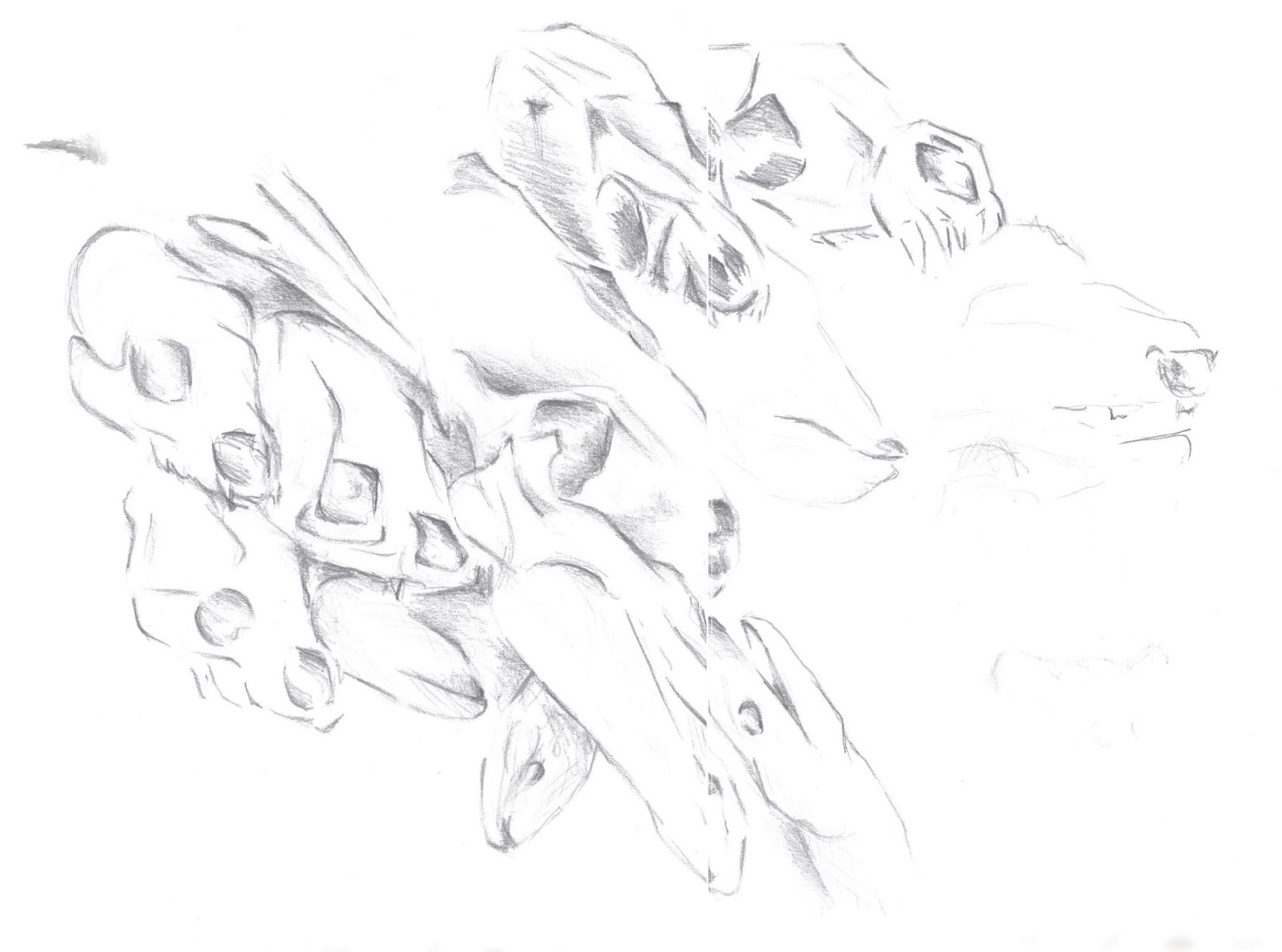
Today, I spent the afternoon being an absolute menace to tourists and children alike by blocking the view of exhibits that I insisted on taking ages to sketch!

In search of some primary research, I set of to Manchester Museum where I looked at skulls and ancient artifacts for inspiration. This is because my research into voodoo culture so far has pointed towards inanimate objects that hold value for the owner.  The reasoning behind the animal skeletons took inspiration from an image of a Voodoo Market in Benin that I found on Pinterest.  Again, we see that inanimate objects are capable of holding deep meanings and serve a greater purpose.


I also found authentic dolls from West Africa and was particularly interested in the ‘Ibeji’ figurines from the Yoruba people of Southern Nigeria. Ibeji, literally meaning twins in the Yoruba language, are wooden dolls whose care and protection ensures the survival of either twin. It is thought that if one twin dies, the other must carry both Ibeji that will then house the soul of the deceased twin.


While at the museum I also came across axe and spear heads. I think this fits in with my concept of ‘protection’ and ‘evil reflected’ as essentially weapons are there to protect but needless to say cause destruction in the process.

Finally, I spent an inordinate amount of time drawing broken bits of ceramics. I guess what I was interested in here was the idea that the broken bits and pieces are almost as important to the museum as other whole objects for the historic value they hold. In a very round-about way, I suppose this echoes the idea of valued objects. Or maybe at this point I was getting a bit desperate!


After this, I continued my wander down Oxford Road to the Whitworth Art Gallery. I didn’t find much that could relate to my research as such but as it’s a contemporary gallery I saw some very interesting installations that might help us a group in terms of how to curate our final outcome.

I was immediately drawn to the video installation by Micheal Landy as it’s pretty much in direct eye-line of the main entrance of the gallery. The main feature of Landy’s very personal work about his father was a video of still images that were projected to a screen suspended in the middle of a large room. This is particularly striking because of the overlay of the artist’s father whistling his favourite tunes as the soundtrack. The overall effect is a little eerie due to the stark feel of the room but oddly familiar and comforting at the same time.

Similarly, the artist Beryl Korot’s installation featured linen and wool weave that were again suspended in the middle of the space. Directly facing this were a row of five television screens embedded into the wall that played a looped documentation of the weaving process. The rhythmic sound and movement of the looms really compliments the repeat geometric patterns of the weave in documenting the meticulous process.


From this, I am interested in how various components can work in harmony with each other to form a cohesive installation and create an overall narrative. I am also interested in how space is used in these installations as both exhibits were quite stark but this only added to their impact. I think this is something we can look towards for inspiration in the later stages of our project.

Overall, I am now rather overwhelmed with ideas indeed. However, it was nice to briefly step away from my own research and look at some more contemporary works of art at the Whitworth, which are all definitely worth a visit!

Tuesday, 9 April 2013

Unit X: Return to Hilton House


Today we found ourselves yet again at Hilton House for our first group meeting after the Easter break. For this we were asked to start pinning up our research onto our allotted wall space so that we could start to see what common ground we had and ideally move forwards with an agreed concept. This was easier said than done!


I think that we might have a bit of a setback as all our research at this stage is quite broad. Also, before the Easter holidays we agreed to continue research on our own strand of suspicions. This may not have been the best idea as it just means that now our research simply does not have enough in common, and naturally none of us are going to let go of our ideas without a fight!

My fear in regards to this is that whilst the research is broad, it is simply not in depth enough.  However, all is not lost. During the meeting, it was something that Rachael said that stood out to me. She found that the definition of Superstition was an ‘irrational fear or belief’.

 su•per•sti•tion (ËŒsu pÉ™rˈstɪʃ É™n) 

n.
1. an irrational belief in or notion of the ominous significance of a particular thing, circumstance, occurrence, etc.
2. a system or collection of such beliefs.
3. a custom or act based on such a belief.
4. irrational fear of what is unknown or mysterious, esp. in connection with religion.
5. any blindly accepted belief or notion.

The keyword here is ‘irrational’ as I think this gives us a concept with which we can evolve our theme. Irrational not only gives us a concept to work towards, but can also be translated visually as a piece that might seem out of control or simply a bit crazy. In line with this, I proposed that we create an installation that is ambitious in scale and impact.

Another idea in regards to the final outcome is to make a fashion film based on fears and suspicions. At the moment it is undecided whether this will be a modernised parody of the theme or perhaps a more sinister tone. Whilst I like the idea of making a film, having had a go at this for my last project, I’m not exactly confident in my filmmaking abilities just yet and fear that I will not be making much of a contribution.

All in all, today has left me feeling more confused than ever about the fate of our Unit X. It might very well be a case of ‘too many cooks in the kitchen’ as in spite of our collective research efforts we are no closer to coming to an agreement. It’s safe to say that at this stage I am very nervous indeed!

Saturday, 30 March 2013

Unit X: Easter Research Round-Up


Over Easter I’ve been fascinated by the idea of ‘Evil Reflected’. This came about from my initial research into voodoo and the talismans, or ‘Gris-Gris’, associated with it. From the book, Voodoo- Mounted by the Gods I came across a particular fetish that took the form of a small doll but had shards of metal and glass protruding from its wooden body. The caption for this image read:

‘This gris-gris is made to both defend the owner and injure others who wish him harm. Inside the fetish are hair and nails from the owner. The body is covered with metal shards and bits of mirror. These two materials are responsible for sensing danger and turning it back. If the owner is cursed, the bad thoughts will be reflected back to the sender and destroy him.’

This struck me as a very powerful and uncomfortable thought that one would wish not only to protect themselves with such charms but would actively hope to cause the death of anyone that may wish them harm. It strikes me as quite a contradictory outlook on the nature of evil as one could argue that by reflecting any bad thoughts, one becomes part of that evil deed.


Anyhow, from looking at the gris-gris I was interested in taking this very abstract notion and translating it through a textile medium. To do this, I have used the process of tucking and pleating in order to create a raised surface onto flat fabric. I’m interested in creating pattern but more importantly a 3d structure out of a flat surface.  I also experimented with sheer fabric to see how the transparency might affect the structure. By utilising the transparency of my medium, I am interested in evoking a sense of fragility. However, at this stage I have only scratched the surface in terms of using fabric manipulation in my work.  To develop this further I hope to recreate my fabric samples in large scale to see how far I can push the structural capabilities of fabric.


Wednesday, 27 March 2013

Unit X: Mr X Stitch


As a continuation on the road to rediscovery of my love of textiles, I thought it was appropriate to include the lecture with Jamie Chalmers, otherwise known in the world of embroidery as Mr X Stitch. Chalmers is an embroiderer, blogger and generally a very funny guy! In his lecture, he introduced us to the work of contemporary embroidery and needle work artists and a few of the exhibitions he has curated within the field. As a strong advocate of banishing feminine stereotypes, I must admit to my own preconceived ideas of the feminine connotations of embroidery and needlecraft. And so I owe the likes Jamie Chalmers thanks for bringing the traditional field into modern art and design. His blog is a testament to the exciting and ever-evolving work in the field. The link to which is here: http://www.mrxstitch.com/


I highly recommend that you take a gander!
What I loved about this lecture was Chalmers’ sheer enthusiasm he had for all the astists included in his (very extensive!) powerpoint. Here are some of the artists (for there were MANY) that stood out to me as inspiration for Unit X.

Melissa Zexter: School Girls (detail) Gelatin Silver Print, Thread

Stacy Page: Kathy, Take me with you

Maurizio Anzeri: Collaboration with Robbie Spencer and Richard Burbridge for Dazed and Confused

Diem Chau: Hair, Hand; Porcelain cup, Silk thread

Thursday, 21 March 2013

Unit X: Today I am Inspired! ( Part 2: Embellisher Induction)

And lo! Like some divine intervention, this morning's lecture was followed by an induction into the embellisher in the embroidery department. I was a bit sceptical about using the embellisher, having seen some of the samples floating around the studio (one of the benefits of the new art and design building is that you get to take a peek at what the textiles students get up to!) as the result looked a little too messy and  resembled too much of crafts projects for my liking. But from today's session I can see its a great way of merging together different fabrics and fibres and I must admit, I had far too much fun doing it! Check out the samples below.


For these samples, I was interested in only embellishing portions of the stands of yarn and fabric layered on top of the base of felt. I purposely left parts of the yarns loose so that the create an extra layer to the overall fabric. I was also interested in working with different textures and densities such as the use of a solid silk fabric in contrast to loose wool fibres to see how they would work together. I love how there are many layers to the final surface as wisps of trapped fibres seem to float outwards as though in suspended motion. 

For today, we were limited to working with the fabrics and yarns that the department already had in their cut-offs box. But I can see the potential in the technique to work with both natural and synthetic fibres. I am particularly interested in layering fabrics of different densities and possibly working with alternative materials such as paper and plastics. These materials wont necessarily blend in with the base fabric because there aren't any fibres that can be felted together but nevertheless I am curious to see what happens. 


Sunday, 17 March 2013

Unit X: Hello my name is... TRISKAIDEKAPHOBIA


No, I haven’t just slammed my fists onto the keyboard; that is our group name! Just rolls off the tongue, does it not?
Triskaidekaphobia, meaning ‘an irrational fear of the number 13’ came about as a result of our first group meeting on Tuesday.
After going through the facts that we’d come up with about 175, there wasn't much that jumped out at us as something we could push forward as a group project. That was until it was pointed out simply that 1+7+5= 13...ground-breaking! Its kind of obvious but the point is we didn't have to use 175 since 13 was a significant number in itself. We came to the conclusion that since 13 is an unlucky number we could begin by looking at superstitions as this gives us a broad scope for ideas at this initial stage. Besides, it’s far more fun to research something morbid!
On Wednesday, we met up again for a group exercise in which we set down some ‘ground rules’.

#1. Warn others if you cannot attend a group session, or workshop

#2  It is your responsibility to catch up on anything that you have missed.

#3 All information is to be shared with the group, either through posting on Facebook or in regular  group meetings.

It's not much of a comprehensive list but the general gist of it is that all members need to co-operate fully and make time for the group.

Our final task for the week was to create a collaborative poster to present to the rest of the group which would demonstrate our chosen theme. An issue that we came across was that we all had our interests and could not yet agree on anything in particular. So we decided that our posters should be a compilation of the various themes we want to look at- with the over-arching theme being superstition. To continue the running theme of the number 13 we decided to make 13 Tarot cards as an additional nod to our theme. We also felt that it was important to maintain a group aesthetic. In order to tackle this issue we decided that our individual posters should share a similar format. So in reference to Tarot cards, we appointed Alex to the prestigious title of official 'card-designer'. The purpose of this was so that the overall look of the posters would be similar whilst giving each individual just enough creative licence.

I think we've made a positive start to the project as each member of the team has taken an active part in the meetings and so far everyone seems to have very diverse and exciting ideas.


Saturday, 16 March 2013

Unit X: Voodoo


When approaching the theme of ‘Superstitions’ my main aim was to stay away from any westernised ideas surrounding this topic. How I arrived at my current theme was purely a result of resolute procrastination and chance.  After an unsuccessful hunt for obscure titles at the MMU library that appeared only on the library search engine, I just so happened to wander into the photography section when I stumbled upon the book ‘Voodoo- Mounted by the Gods’.  Filled with beautiful photographs, the book captures the journey of the Swiss photographer Alberto Venzago that began in 1988 as he documented for 10 years his fascination with the Voodoo culture of Benin. Through this and the accompanying documentary, Venzago sheds light on the mysterious subculture and gives access to the rules and rituals of this world of African Voodoo.


'voodoo is about sorcerers saints demons and tricksters. It’s about the dark powers that made us survive'
The quote above, taken from the accompanying documentary is particularly poignant as the endurance of voodoo culture is attributed to the historical context of the slave trade in Africa, a time in which it was believed to the ‘essence of Mother Africa’.  I think it’s a nice idea that it is the people’s beliefs that allowed them to maintain a sense of identity during such a tragic time. I am intrigued by the value and power that faith can hold for the people who live their lives by it, however bizarre its practices and rituals may be to outsiders.


What also interests me was the use of objects and talismans illustrated in this book. Objects called ‘Gris- Gris’, that do not simply come in the form of dolls as popular culture would have us believe, serve different functions to the holder. Some are a source of healing, whilst others a means of protection against harm. As my practice is based in fashion and textiles, I’m very much interested in continuing to work in a 3D format and so I think that looking at actual objects as a source of inspiration could give me a lot to work with by way of silhouettes to recreate materials to look into and silhouettes to recreate. 

Monday, 29 October 2012

Generating Fashion: Tutorial/ Sketchbook Update

From working on my toile earlier on in the week I was trying to work out how to make my individual components work as part of a functional garment.  


This has lead me to look into 1940s utility as part of my ongoing research. I have decided to make a jacket which incorporates the feature 'vertebrae' back detail that I have been experimenting with on the stand. This design combines my previous research into abstract form as I intend to manipulate and drape the fabric in a way that it falls in a distinctive protruding shape away from the body. I have chosen to make a jacket in reference to utility wear as it is a functional garment that aims to protect the wearer from the elements. The vertebrae shape references a sense of austerity and constriction but the use of excessive fabric required to create drape goes against some restrictions of fabric and garment construction of the time- i.e. limitations on about of fabric/buttons used.This is very much the opposite of the restrictions on fabric usage of the time but I feel that it is the juxtaposition of the two ideas that creates a deeper narrative for the piece.


From my Tutorial this week Sarah had suggested that I continue to research this but I need to fully exhaust this research by looking at more specific components such as pocket and to incorporate them into my design process.


Friday, 26 October 2012

Generating Fashion: Sketchbook/Tutorial Update

This week my task was to produce 20 designs in order to make a start on toiling for the final garment for this project. The designs I have produced so far have been inspired by my 'Macabre' research as well as drawings of beetles that I did last week from Manchester Museum. The idea behind this is that I am interested in the way beetles have a cocoon like outer shell that acts as a protective element for a soft inner core. From this I want to create a balance between constriction and protection. This is apparent in my designs as I have tried to play with the element of the stacked collar.


However, from my tutorial Sarah thought that I had not pushed my designs far enough and that they were too conservative. She suggested that I continue to explore shape and form so that my collection is more innovative and visually exciting. Guess its back to the drawing board!

Saturday, 20 October 2012

Generating Fashion: Tutorial/ Sketchbook Update

I think that this week I have finally hit my stride in terms of research and I am starting to develop a theme. I have sought to elaborate on my research from Yorkshire sculpture park into abstract and irregular forms and begun to expand on this with research from other sculptors such as Giacometti. I am interested in these sculptors because of the way they use texture in their bronze works. I think I could explore this unevenness of texture further through fabric sourcing and sampling as it would provide a point of interest in my final garment.

Generating Fashion: First Cut Exhibition


This week, the Manchester School of Art held a formal evening reception for first year art students at the Manchester City Gallery. This was a chance for the Dean of the School of Art to formally introduce himself as well as an opportunity for us students to potentially mingle with the city’s ‘creative and cultural sector’.  As well as this, currently the gallery is hosting the First Cut, which was a relief as my networking skills are not quite up to scratch!


The exhibition invites 31 international artists who work specifically with paper to push their practice even further in order to create what were truly awe-inspiring works of art. On one end of the spectrum were controversially charged works such as the intricately detailed cutwork scenes by Kara Walker which depict a provocative narrative of African-American history. In contrast the sculptural piece entitled ‘Roil’ by Mia Pearlman appears to conjure the humble material out of its basic form into a majestic explosion that appears as though it has been frozen in time.


My favourite piece of the exhibition was definitely the miniature piece entitled ‘Fotocken’ by Sarah Bridgland. The artist works with found objects on a small scale as in this case she has used a found German photo corner-mounts box and embellished it with a microcosm of cut outs and pop-up imagery. I love her quirky style and her ability to breathe new life into the most mundane, discarded objects. In this way I think that the piece epitomises the spirit of the exhibition.